

Podcast Marketing Strategies for Founders & Brands
Podcast marketing is not about publishing more episodes. It is about building a repeatable system for discovery, distribution, and engagement. This guide breaks down practical strategies to grow your podcast intentionally, build audience trust, and turn episodes into long-term brand value.

Introduction
Podcast marketing often looks simple from the outside. Publish an episode, share it on social media, and wait for the audience to grow. But in practice, that approach rarely works for long.
Many podcasts fail to grow, not because the content is weak, but because there is no clear system behind it. Episodes go live without a distribution plan. Promotion happens inconsistently. Growth depends on luck rather than intent. Over time, the podcast starts to feel like an effort without return.
The podcasts that break through take a different approach.
They treat their show as a media product, not a side project. Every episode is planned with discovery in mind. Distribution is built into the workflow. Engagement is measured beyond downloads, focusing on retention, relevance, and audience ownership.
If you already have a podcast or are serious about launching one, this guide is designed for you. It walks through practical podcast marketing strategies you can apply episode by episode to increase visibility, build trust, and turn your podcast into a sustainable growth channel for your brand.
What is Podcast Marketing?
Podcast marketing is the system used to distribute, promote, and grow a podcast across platforms such as Spotify, Apple Podcasts, YouTube, and search. It combines distribution, podcast SEO, and content repurposing to improve discoverability through optimized titles, descriptions, show notes, and video clips.
Effective podcast marketing focuses on expanding reach while increasing listener retention and engagement. Strong podcast marketing turns episodes into owned audiences, qualified leads, and measurable business growth through consistent promotion and analytics-driven optimization.
Strong podcast marketing also emphasizes audience growth. Cross-promotion with other podcasts, guest collaborations, and community building introduce your show to relevant listeners who are already interested in your niche.
Beyond audience growth, podcasts can be powerful tools for lead nurturing and business partnerships. By offering premium content, sponsorship opportunities, or exclusive access (e.g., webinars, industry reports), you can generate revenue streams while continuing to provide value to your audience.
Over time, these efforts support monetization paths such as partnerships, lead generation, or branded content, depending on your goals.
To turn podcast marketing from a one-time effort into a repeatable growth system, you need more than isolated tactics. You need a clear understanding of how discovery, distribution, and engagement work together at every stage of your podcast’s lifecycle. Let’s understand practical actions you can apply to market your podcast.
How to Market Your Podcast: Proven Strategies
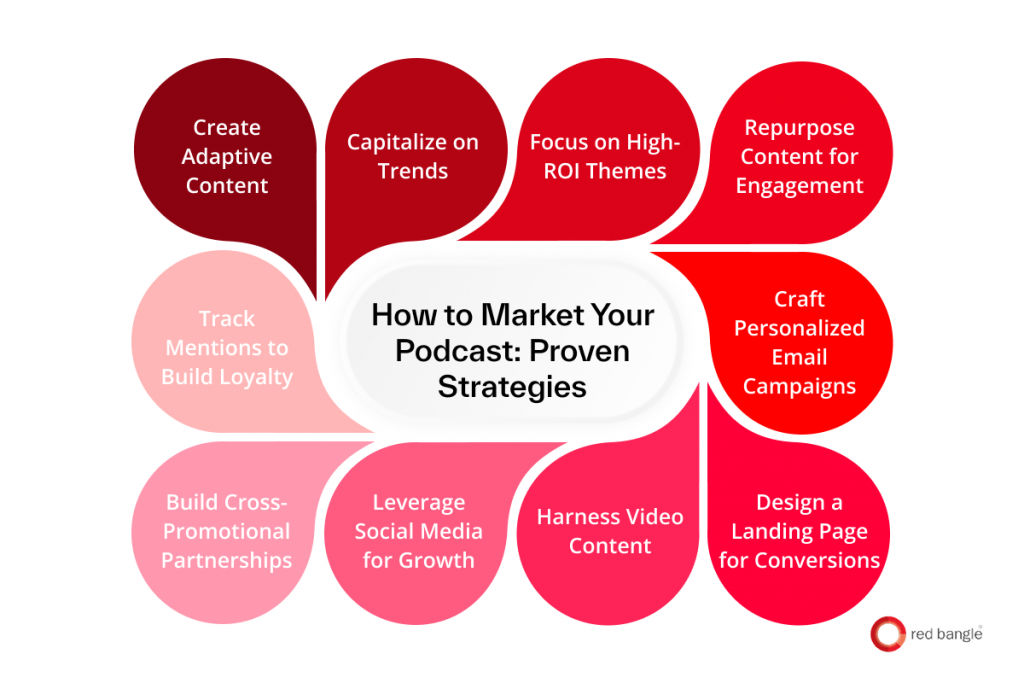
Marketing a podcast works best when you follow a clear and reliable system rather than relying on one-off promotions. The strategies below focus on actions you can take episode by episode to improve discoverability, engagement, and long-term value of your podcast.
At every stage, the goal is not more episodes or more downloads, but stronger listener signals like retention, repeat listening, and owned audience growth.
1. Create Adaptive Content Across Platforms
This strategy is primarily about discovery. Most listeners today encounter podcasts while scrolling, searching, or watching short-form content.
Adaptive content helps your podcast show up in the places where new listeners already spend time scrolling, searching, and watching. By reshaping one episode into multiple formats, you increase visibility without increasing production effort.
For example, short video clips perform well on YouTube Shorts and Instagram Reels, while mid-length videos (mids) are increasingly effective on YouTube for deeper discovery and watch time.
YouTube posts can also be used to resurface episode highlights, quotes, or updates between uploads. Audiograms and quote cards fit naturally on LinkedIn, and written summaries and blog posts get your podcast discovered in search results.
The biggest improvement comes when you have a content amplification plan even before you record. In fact, promotion does not have to be locked in early. Distribution can happen after an episode goes live, as long as the content is designed to be reusable. To make this practical:
- Identify key moments that can become clips
- Plan three to four formats per episode
- Map each format to a specific platform based on how your audience consumes content
To maximize growth, start by optimizing content for discoverability on platforms like YouTube and social media. Move listeners to consideration with valuable content like interviews and case studies, then drive conversion with clear CTAs prompting actions like subscribing or booking a consultation.
2. Capitalize on Trending Topics
Once your content adapts across platforms, relevance becomes the next growth factor.
Trending topics help bridge that gap. When you align episodes with current industry conversations, you give people a reason to listen now rather than later.
Creating content on trending topics also makes your podcast more timely and useful. Listeners are more likely to click, share, and recommend episodes that reflect what they are already reading or hearing elsewhere.
To do it, you do not need to chase every trend. The key is choosing topics that naturally fit your expertise and audience expectations. By linking your podcast content to real-time industry developments, your podcast becomes more relevant and timely, ultimately driving deeper engagement.
Here are simple ways to stay aligned on what’s trending in your industry:
- Set up BuzzSumo alerts for trends in your niche
- Track LinkedIn discussions or industry forums to gather insights into what resonates most with your audience.
- Use Google Trends to confirm rising interest before recording
- Frame episodes around timely questions your audience is already asking
3. Identify and Focus on High-ROI Podcast Themes
Trending topics can drive interest, but consistent growth comes from focus.
If your podcast jumps between unrelated topics, listeners struggle to understand why they should keep coming back. High-performing podcasts avoid this by committing to a small set of themes that clearly serve their audience.
You can identify your podcast themes by paying attention to the signals your audience already gives you. To clarify your high-ROI themes:
- Run targeted audience surveys using Google Forms
- Review recurring questions from emails or comments
- Align themes with long-tail keywords that show intent
This is where a structured approach makes a real difference.
For example, when we work with clients at Makerrs, the process starts well before recording begins. We study industry trends, successful podcast formats within the category, audience expectations, and the kinds of conversations that already exist in the market.
The result is a podcast that feels intentional and coherent, and one that listeners return to because they clearly understand what the show stands for.
4. Repurpose Content to Multiply Engagement
Once your themes are clear, repurposing becomes far more effective. Instead of scattering content across platforms, you are reinforcing the same core ideas in different formats. This helps your audience engage at their own pace.
A short clip might introduce someone to your perspective. A blog post might help them understand a specific idea before listening. Each format supports the next, guiding people toward deeper engagement without pressure.
This approach works best when it is consistent. When every episode feeds multiple channels, your podcast stays visible even between releases. To keep repurposing useful:
- Use tools like Descript to pull out insight-driven clips
- Turn transcripts into structured, search-friendly articles
- Share moments that deliver clear takeaways, not summaries
As you implement strategies like content repurposing, it’s crucial to track (KPIs) to measure success. Track key performance indicators like listener retention, completion rates, submissions, and bookings to measure podcast success beyond downloads.
Pro Tip:
Use UTM parameters for attribution tracking, linking podcast traffic and conversions to business outcomes. For instance, if your podcast promotes a special offer or exclusive content, track how many leads convert to paying customers.
This will help you assess the direct ROI of podcast marketing efforts in terms of revenue generated, beyond just downloads.
5. Craft Personalized Email Outreach Campaigns
As your podcast reaches more platforms, email becomes the channel that brings everything together. Unlike social media, email gives you direct access to listeners who have already shown interest in your podcast. That makes it one of the most reliable tools in podcast marketing.
Personalized email sequences help you guide listeners toward episodes that match their interests. Instead of sending generic announcements, you can recommend conversations based on themes, highlight popular episodes, or add context that deepens understanding. Over time, this builds familiarity and keeps your podcast top of mind.
To make email work smoothly for you:
- Segment subscribers by topic or interest
- Use tools like Mailchimp to automate sequences
- Focus on helpful recommendations rather than promotions
When email supports your broader podcast marketing efforts, it becomes a powerful retention and growth channel.
6. Design a Landing Page to Convert Listeners
As your podcast reaches more people across platforms, you need a clear place to send them next. A dedicated podcast landing page helps you turn casual listeners into subscribers, leads, or repeat visitors instead of losing them after a single episode.
A strong landing page removes friction. It gives visitors immediate access to your latest episodes, explains what your podcast is about, and makes the next step obvious. This could be subscribing, joining your email list, or accessing exclusive content. When listeners know exactly what to do next, conversion becomes easier.
For example, B2B International uses its podcast landing page to clearly position the show, surface all episodes in one place, and guide visitors toward deeper resources.
Similarly, PwC structures its Pulse podcast series as a central hub, combining episodes, expert context, and clear navigation paths that make it easy for listeners to explore, subscribe, and stay engaged beyond a single episode.
To make your landing page effective:
- Use platforms like Leadpages or Unbounce for fast setup and testing
- Include clear calls to action that match your primary goal
- Optimize for search with episode summaries, keywords, and show notes
Quick Tip:
In addition to optimizing your landing page, ensure that your podcast episodes are optimized for search engines. Refine descriptions, tags, show notes, and transcriptions for platforms like Google, Spotify, and Apple Podcasts. Tools like SEMrush can help you identify business-related keywords that will increase your visibility and attract the right audience.
7. Harness the Power of Video
According to Google, more than 1 billion people now check out podcasts on YouTube every month, marking a major shift in how audiences discover and consume podcast content. This change means podcasts are no longer found only inside podcast apps. Instead, they increasingly surface through video-first platforms.
What matters here is not cinematic production, but clarity. Clean visuals, readable captions, and focused edits are often enough to attract new listeners and help them understand why your conversation is worth their time.
Here’s how you can start using video podcasts effectively:
- Upload full episodes to YouTube with optimized titles and metadata
- Create short clips that highlight strong insights or moments
- Use video as a discovery layer, not a replacement for audio
For example, at Makerrs, we applied this approach in an executive video podcast featuring senior leaders from Stanley Black & Decker.
The episode was designed as a long-form conversation exploring leadership, transformation, and strategy in depth. At the same time, individual moments from the discussion were intentionally shaped to stand on their own as short clips.
8. Utilize Social Media for Brand Exposure and Audience Growth
At this stage, social media is no longer about driving clicks. Its role is familiarity. Repeated exposure builds recognition, trust, and a sense of community around your podcast.
When listeners regularly see your ideas in their feed, your podcast becomes recognizable even before they subscribe. Engagement also increases when content invites participation rather than passive consumption.
To keep social media effective and manageable:
- Schedule posts using tools like Buffer or Hootsuite
- Share insights, industry-specific takeaways, and episode highlights that resonate with your target decision-makers
- Encourage guests to share episodes with their own professional circles, expanding reach to new audiences in the same industry or market segment.
Over time, these touchpoints strengthen brand recall and listener loyalty.
9. Build Strategic Partnerships Through Podcast Cross-Promotion
As your podcast grows, partnerships shift from a growth tactic to a distribution strategy.
Brands use cross-promotion to extend reach by placing their podcast inside trusted industry platforms that already attract the right decision-makers. These partnerships introduce episodes with context and credibility, driving intentional discovery and sustained engagement.
Guest appearances and episode swaps also work because they introduce your podcast through trusted voices. Over time, these partnerships also strengthen your network and industry presence.
The key is relevance. Cross-promotion works best when both podcasts serve similar audiences and offer complementary perspectives. To approach cross-promotion thoughtfully:
- Identify podcasts that share your target audience
- Propose guest interviews or episode swaps with clear value
- Track subscriber growth after collaborations to measure impact
10. Track and Respond to Mentions to Build Brand Loyalty
As your podcast gains visibility, people will start mentioning it across platforms. These moments are opportunities to deepen relationships rather than signals to ignore.
Listener mentions signal engagement, interest, and advocacy. Tracking these moments allows you to respond in real time and strengthen relationships with your audience. When listeners feel acknowledged, they are more likely to share your podcast again.
To build loyalty through engagement:
- Set up Google Alerts for your podcast name
- Use tools like Mention to track social references
- Respond to listener posts and reshare user-generated content
When listeners feel seen and acknowledged, they are more likely to return, recommend your podcast, and stay engaged over time.
Once your podcast consistently reaches the right audience and keeps them engaged, its value extends far beyond downloads. At that point, podcast marketing begins to support brand authority, relationship building, and long-term business growth.
Now, let’s look at why podcast marketing matters in 2026.
Why Podcast Marketing Matters More in 2026?
Podcast marketing is no longer just a visibility play. As digital channels become more crowded and trust harder to earn, podcasts offer a way to build attention, credibility, and long-term relationships at the same time. In 2026, this combination is what makes podcast marketing especially relevant for businesses focused on sustainable growth.
- Builds Brand Authority:
In 2026, trust is harder to earn through short-form or promotional content alone. Podcasting allows you to demonstrate expertise through consistent, long-form conversations that show how you think, not just what you sell. Over time, this positions your brand as a credible voice in its space. - Increases Audience Engagement:
As attention becomes more fragmented, podcasts remain one of the few formats where audiences spend extended, uninterrupted time. This deeper engagement leads to stronger recall, repeat listening, and a clearer understanding of your perspective and values. - Expands Reach:
Podcast marketing now spans audio platforms, YouTube, short-form video, and search. This multi-platform presence helps you reach both global and niche audiences across discovery surfaces that continue to diversify in 2026. - Enhances Customer Loyalty:
A consistent publishing cadence creates familiarity and expectation. When listeners return regularly, your podcast becomes part of their routine, strengthening long-term loyalty and ongoing engagement beyond individual episodes. - Creates New Revenue Streams:
Podcasts support flexible monetization models, including sponsorships, partnerships, premium access, and content-led offers. In 2026, these revenue streams are increasingly tied to audience quality and engagement rather than scale alone. - Content Repurposing:
Each episode can be repurposed into blog content, video clips, newsletters, and social posts. This extends the lifespan of your ideas and improves return on effort by allowing one conversation to support multiple channels and goals.
Conclusion: Transform Your Podcast Marketing Today
Podcast marketing delivers results when it is treated as a long-term system, not a one-time promotion. The strategies covered in this guide work because they focus on how people actually discover, engage with, and return to podcasts over time.
When you combine clear positioning, consistent distribution, thoughtful repurposing, and audience-first engagement, your podcast becomes more than content. It becomes a reliable channel for building trust and influence.
The real shift happens when podcast marketing aligns with your broader business goals. Instead of chasing downloads, you start measuring relevance, retention, and relationships. That is when a podcast begins to support brand authority, customer loyalty, and sustainable growth.
At Makerrs, we help teams move beyond experimentation by connecting strategy, production, and distribution into a single, focused approach.
If you want to turn your podcast into a growth asset rather than just another content initiative, book a strategy session with our team to explore how a structured podcast marketing plan can deliver measurable, long-term value for your business.